Tonight We’re Gonna Party Like It’s 2027
In 2024 an essay pictured the AI future in enough detail that people could invest in it. The investments made the picture look truer, until a few days in July 2026, when prices fell and the investments started working against it.
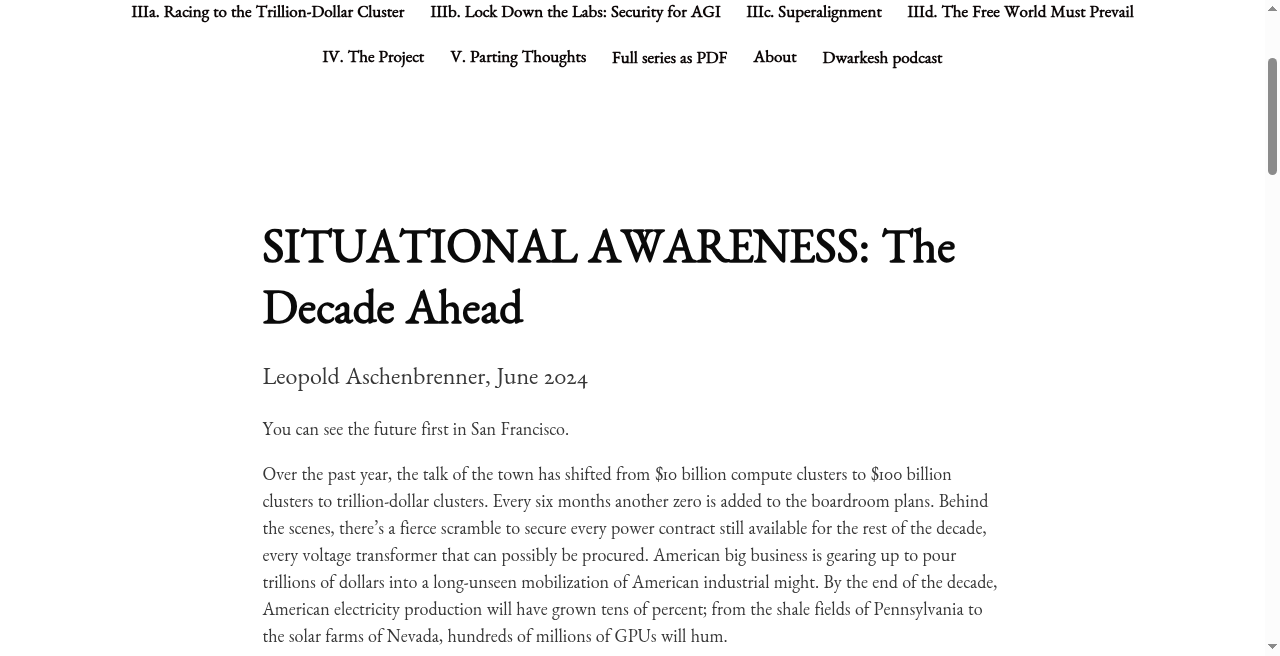
In June 2024, Leopold Aschenbrenner put 165 pages on the internet describing a world that did not exist yet.
It had dates.
It had charts.
It had trillion-dollar computing clusters, government projects, machines better than humans at nearly everything, and a narrow group of people in San Francisco who understood what was coming before everybody else did.
The document was called Situational Awareness. Its central claim was unusually simple for something that long: advanced artificial intelligence was coming very soon, and the people who understood that fact early would have an enormous advantage.
Aschenbrenner did not write as though he were guessing.
“I can see it,” he wrote. “I can see how AGI will be built.”
That sentence changed how the essay was read.
The future had not happened. The machines were not there. The clusters were not there. The sudden leap in machine intelligence it predicted had not happened.
But there was now a detailed picture of all of them.
And people began making decisions based on it.
Computer scientist Scott Aaronson called the essay one of the most extraordinary documents he had read. Michael Dell shared it. Ivanka Trump shared it. Investors passed it around. People in technology and national security argued over its timelines as though the only real question was whether it would all arrive in 2027 or a little later.
People make predictions every day. The strange part was how quickly this one came to look like a record of something that had already happened.
There were charts to point at. Numbers to quote. A sequence of events. Winners and losers. Industries that would matter. Industries that would not. A story about who understood the world and who was still asleep.
It was detailed enough to plan around.
Then Aschenbrenner built an investment fund around the same view.
The fund took the same name as the essay: Situational Awareness.
By 2026 it reportedly managed more than twenty billion dollars. Its bets followed the world described in the document. Companies positioned for enormous AI demand went up. The fund went up with them. The fund’s success made the essay’s predictions look more convincing.
This is what can happen when people can bet money on a prediction.
When enough money is bet on it, the betting itself starts to look like proof that the prediction is right.
A company expected to dominate the AI future becomes more valuable because people expect it to dominate the AI future. Its rising value then becomes evidence that the expectation was correct.
The prediction starts changing the very things it was trying to predict.
For a while, this worked in the fund’s favor.
The fund reportedly gained more than a thousand percent from launch. By the middle of 2026, financial profiles described Aschenbrenner as one of the most successful young investors in the world. Traders watched the fund’s filings and copied its positions.
A document about the AI economy of the future had become a fund that moved real stock prices in the present.
People were making money from a future that had not arrived.
Then, over a few days in July 2026, it all went the other way.
The stocks the fund’s strategy depended on fell. What it had bet against went up. The fund had borrowed heavily to increase the size of its bets, and lenders demanded more collateral to cover the loans as prices moved against it.
Investments had to be sold.
Selling pushed prices lower.
Lower prices forced more selling.
Roughly thirty-five billion dollars of market value disappeared from the investments caught up in the forced selling, according to reporting afterward. Regulators began examining the collapse. Aschenbrenner has not been accused of wrongdoing.
Nothing unusual happened in the markets. This is what has always happened when confident investors borrow heavily and prices start to fall.
The strange part was the essay itself.
A hundred and sixty-five pages had described a future that did not exist yet in so much detail that people put billions of dollars into it.
For two years, it got harder and harder to tell the prediction apart from proof.
Every rising stock price made it look more certain.
Every new investment made it seem more inevitable.
Every person repeating the timeline made the timeline feel less like a prediction.
Then the prices moved the other way, and suddenly the essay was only a guess about the future again.
The original document is still online.
The charts are still there.
The dates are still there.
Near the beginning, the sentence is still there too.
“I can see it.”
The future it describes still has not arrived.
For a while, people spent and invested as if they were already living in it.