A Missing Four-Year-Old Was Good for Traffic
A four-year-old walked off a sheep station in South Australia, and within days people who had never been near the place were using his name to get clicks and shares. Every invented breakthrough travelled further than the facts did.
Four-year-old Gus Lamont was last seen on a Saturday in late September 2025, playing on a mound of dirt at his family’s homestead south of Yunta, in South Australia’s outback. When his grandmother came back, he was gone.
Police, emergency volunteers and soldiers searched the property. Drones flew. Trackers walked. Assistant Commissioner Ian Parrott told the public there was no evidence of foul play, and that they believed the boy had wandered off. Trackers found no footprint trail they could follow. No trace of his hat or his Minions shirt turned up.
A search that finds nothing does not make an exciting post. Within days, people had made up more exciting ones.
On Facebook and Instagram, pages put up an image of a man loading a curly-haired blonde child into a four-wheel drive, under the words is this a kidnapping case? Some versions ran it as a breakthrough — an eyewitness sighting about a hundred kilometres from Yunta. Real photographs of Gus and of the search were cut into the same collage, so the invented part looked more believable.
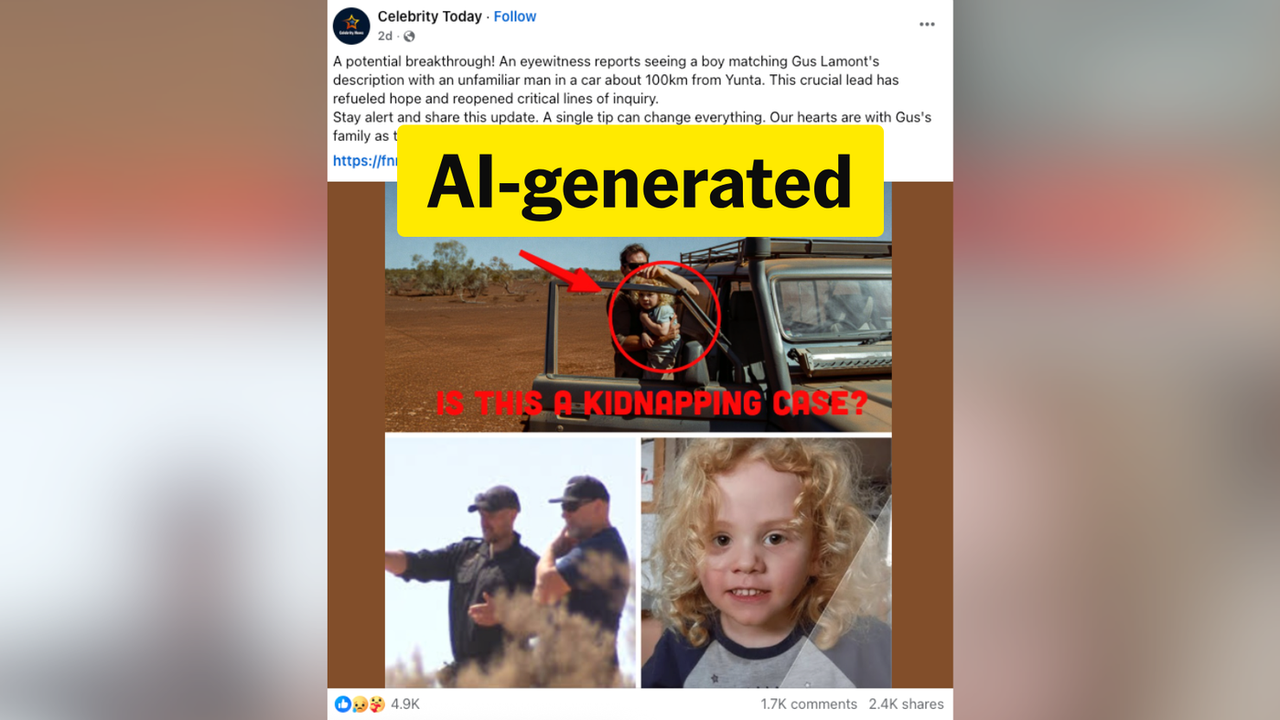
The caption on that post asked people to stay alert and share the update, because a single tip can change everything, and said its hearts were with Gus’s family. People shared it by the thousands. Some of them believed he had been found.
Nobody running those pages was looking for Gus Lamont. His name was being searched and shared, and pages like these post about whatever people are searching and sharing, to get clicks.
The claims got wilder as the pages competed with each other. A miracle in the outback. A reunion with his loved ones, staged with police in American-looking uniforms. A soaked backpack. A hidden cave. Bloodstains. A body part. One Facebook AI search answer told users a toy had been found “with blood on it,” and that the boy was alive.
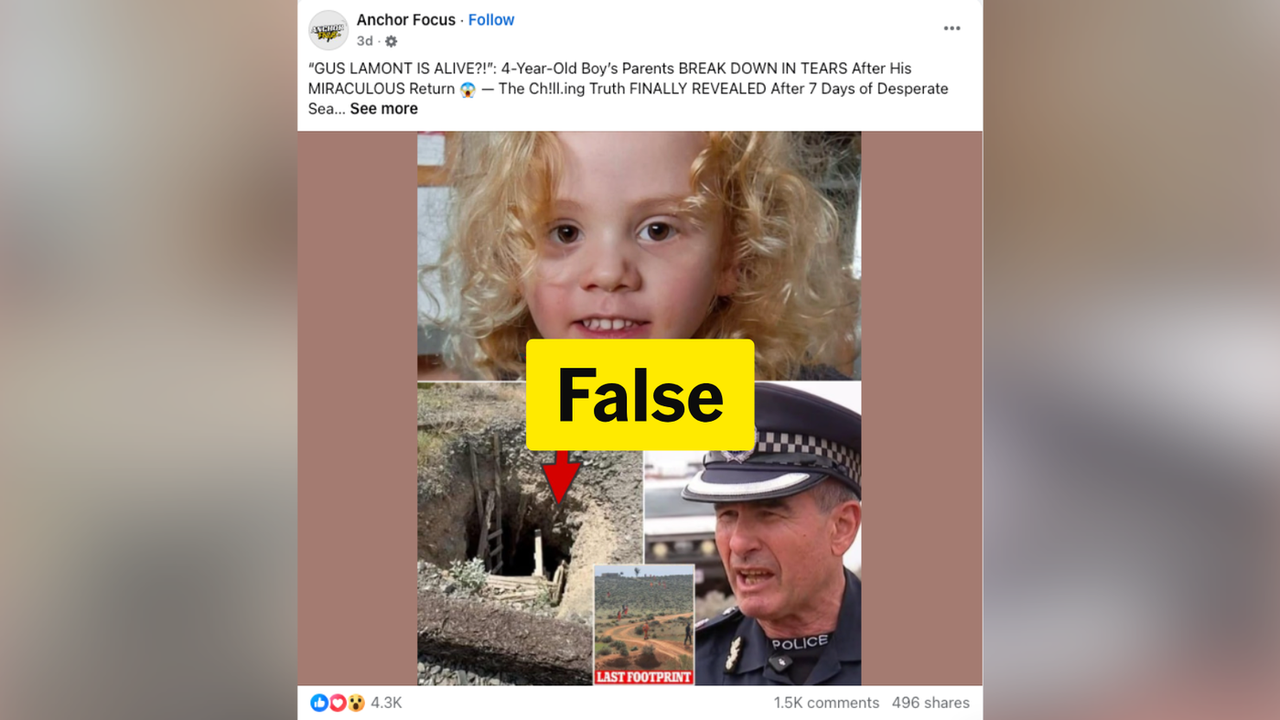
South Australia Police told AFP Fact Check the image of the man with the child was “not factual.” Look closely and the man’s fingers warp; a tree floats like a ghost. AAP FactCheck traced engagement-bait pages managed from Vietnam. Nothing about the outback mattered to them. That week, posts about Yunta got the clicks. The week before it had been some other place, and the week after it would be another.
SA’s Commissioner for Victims’ Rights, Sarah Quick, said the fakes added an “extra layer of trauma” for a family already overwhelmed, and had “very real consequences” for the people still looking. The people making the posts were counting clicks and shares. What the posts did to the boy’s grandmother was not part of that count.
Police scaled back the search on the ground. Online, the pages kept inventing new breakthroughs.
Digging a shaft costs money. Flying a drone costs money. Walking the ground south of Yunta took police and volunteers and soldiers, and it turned up nothing. Making the picture cost nothing at all, and it was the only part of that week’s work that made anyone money.